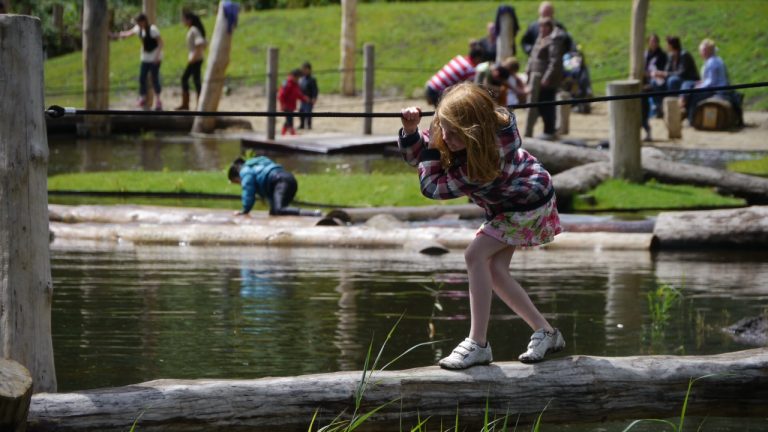
Risk is essential to childhood – as are scrapes, grazes, falls and panic

Photograph: Susan K/Getty Images/Flickr Open

The Guardian author Kate Blinco hits the nail on the head with her article discussing the value of risky play for children and why parents need to back off and let their kids get bruised. Children need to be exposed to risky play. For ‘helicopter parents’, this might be difficult – but kids need to … Read more

The Flip Flop Factor

Why Day Care Kids Don’t Play Outside Article originally published by the New York Times Outdoor play at day care centers is often stifled because a child arrives wearing flip-flops or without a coat or because teachers don’t feel like going outside. Those were some of the surprising findings from a new study of children’s … Read more

Charter For Children’s Play

Children play best: When adults are watchful but not intrusive, when safe ground lends courage to their discoveries and adventures. When their trust in life is whole, when they welcome the unknown and are fearless. When the world is shared with them. When there are places and spaces they can make their own. When their … Read more

How Toys Impact Children’s Development

Michael Jayne shares his findings about how toys can impact a child’s development and why we might want to put a bit more thought into the toys we purchase and give our children.

Considering the amount of time children spend playing with toys, it seems strange that so little attention has been drawn to their contribution to development. It is even more surprising that the apparent disparity between girls’ and boys’ cognitive abilities in later years lasting into adulthood, especially concerning boys’ average higher aptitude for spatial and mathematical tasks or girls’ talent for empathy and language, has not been linked to the dualistic, gendered nature of children’s toys and the media.

Read more

School Starting Age: The Evidence

Here is an article published by the University of Cambridge which discusses the advantages of starting formal schooling later and delaying literacy lessons until the age of 7. We tend to agree and that is why our preschool programs include children age 5 and 6. Studies have compared groups of children in New Zealand who … Read more

Re-Thinking the Colorful Kindergarten Classroom

The space we inhabit on a daily basis leaves a deep impression upon our psyches. How calm or busy this environment is can say much about our inner lives though for most of us we don’t even notice it. One of the most significant differences of a Waldorf classroom is the quality contained within the space. … Read more

The Vital Role of Play

Why is it so important that we give our children opportunity for free play? How could sending my child to an enrichment activity possibly harm their development? Joan Almon explores the rational behind the “play principle”… “creative play is a central activity in the lives of healthy young children. It helps children weave together all … Read more

Raising Kids Who Care

Young children are increasingly engaged in structured activities such as dance, music, soccer and while these are good they are losing the opportunity for unstructured play and it’s hurting their development.

Playing in a playground where every tree is carefully planted has a different quality than play that takes place in a natural environment. Think back to a camping trip where your children played for hours barely supervised and imagine spending even an hour at the park that way.